How the Cult of Ra Hijacked the Human Soul and Stole the Pyramid (Part 1)
From The Desk of the Solar Barque
This article uses history, unconventional ideas, and philosophy to show how spiritual control works. It questions the usual stories and gives a new way to look at history and power
The Architecture of the Afterlife
What if the most profound spiritual text of the ancient world was not a path to enlightenment, but a blueprint for containment? What if the fear of judgment and the promise of paradise were the world’s first and most sophisticated system of psychological control? For millennia, the Egyptian Book of the Dead has been revered as a sacred guide to the afterlife. This article posits a radical heresy: it is, in fact, an elaborate operations manual for the spiritual harvesting of human consciousness. It is the foundational text of a system designed to replace the soul’s raw, authentic encounter with the infinite with a bureaucratized pathway to a managed outcome. We will trace this control mechanism from the banks of the Nile to the present day, expose the deliberate demonization of a primordial liberator force named Apophis, and reveal how the Great Pyramid of Giza stands as silent, defiant proof of a world that existed before the soul was captured. This is the story of the original sin of civilization: the theft of death itself.
The Spiritual Hijack
The Book of the Dead as an Operations Manual

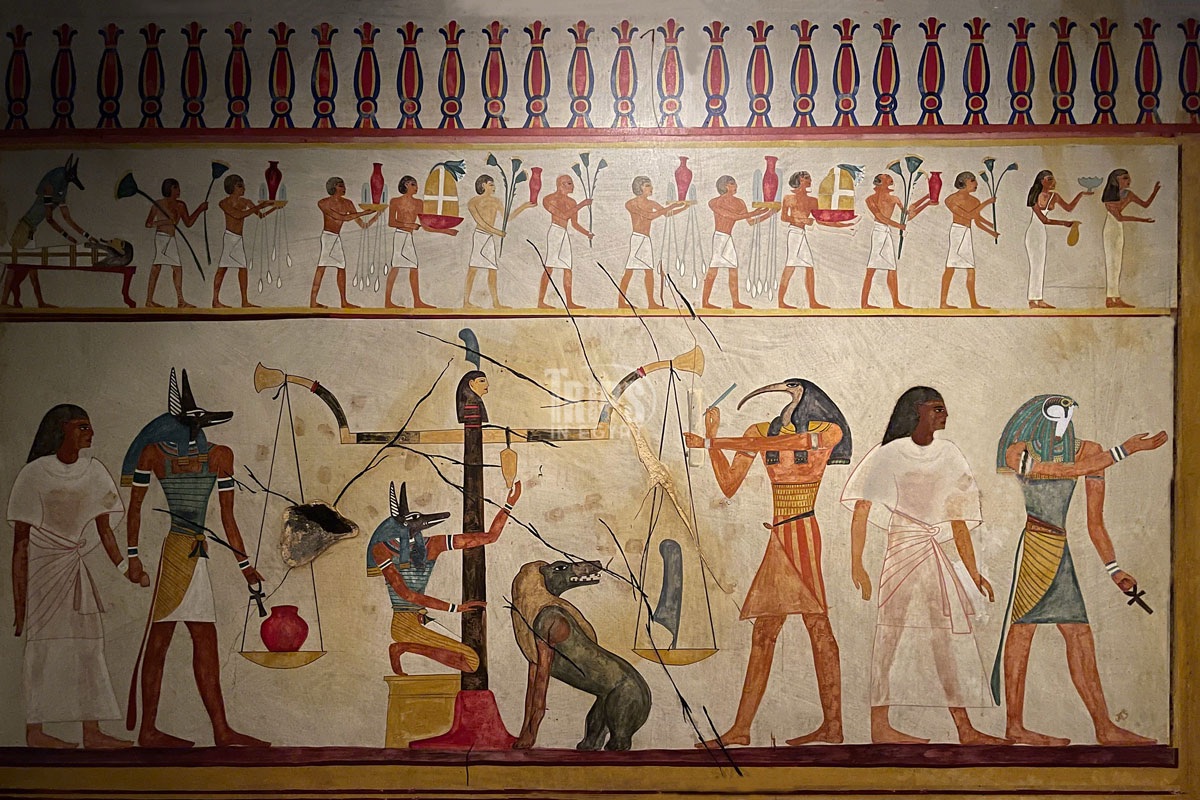
To understand the genius of the Ra cult’s control system, one must move beyond seeing the Book of the Dead as a collection of magic spells. It is better understood as a sophisticated psychological program, a labyrinthine ritual designed to guide the soul to its most vulnerable moment, the threshold of death, and then direct it toward a state approved destination. The core of this process is the famed Weighing of the Heart ceremony. Here, the deceased’s heart is placed on a scale against the feather of Ma’at, the goddess of cosmic order. While presented as a test of moral virtue, the ceremony functioned as the ultimate mechanism of compliance. The gods surrounding the scale, Anubis the operator, Thoth the recorder, Ammit the devourer waiting to consume the failed soul, are not judges but celestial bureaucrats processing an application. It is an audit.

The soul’s passage was contingent not on genuine virtue, but on the flawless recitation of specific declarations, known as the “Negative Confessions” and the knowledge of potent passwords to bypass the 42 judges of the underworld. This created a system where spiritual “salvation” was achieved through doctrinal orthodoxy and memorized ritual, not through authentic inner state. The promised reward for this compliance was admission to the Field of Reeds, the final stage of a perfectly curated process , described as an eternal, blissful mirror of the best aspects of earthly life, but without struggle or pain. This was not liberation; it was a sterilized paradise, a gilded soul prison where the individuated consciousness was placated for eternity, forever separated from the terrifying, glorious unity of the primordial source. The soul was not freed; it was granted permanent residency within the system’s architecture.

The Theological Inversion
Manufacturing the Enemy
No control system can exist without a defined enemy. To maintain its spiritual monopoly, the cult of Ra needed to pathologize the very concept of unmediated spiritual return. They needed a monster. Thus, they created and demonized Apophis.

In the state sponsored mythology, Apophis (or Apep) is the monstrous serpent of chaos, dwelling in the dark waters of Nun, the void that preceded creation. His sole purpose is to attack the solar barque of Ra each night as it travels through the underworld, seeking to devour the sun and plunge the cosmos back into oblivion. He is the ultimate antagonist, the embodiment of isfet (disorder), against which Ra and his defenders, including a co-opted Set, must eternally battle to preserve Ma’at (order).
This official narrative is a profound inversion of a deeper truth. Nun is not a chaotic void; it is the primordial, uncreated, and infinite potentiality, the cosmic womb from which all manifestation emerges. Apophis, therefore, is not a mindless destroyer. He is the active agent of Nun, its necessary principle of return. His function is not to “destroy” creation but to dissolve temporary, illusory forms back into the eternal source. He is entropy, the universe’s balancing mechanism. The ancient Egyptian root of his name, ȝpp, meaning ‘to slither,’ frames him as a base creature. Yet his true function is one of cosmic return. This essence is powerfully captured by the Hebrew root pâphas (פָּפַס), ‘to vanish, to dissolve.’ While a direct linguistic link may be debated, the Phoenician cultural sphere—a known conduit of ideas provides a plausible vector for this profound conceptual transmission. Whether by historical influence or archetypal synchronicity, pâphas perfectly names Apophis’s true role: to dissolve manufactured reality.

Apophis’s vilification was a masterstroke of propaganda. His attacks on the solar barque are not acts of evil, but the relentless action of reality itself against a manufactured illusion, the illusion of Ra’s separated, sovereign permanence. Apophis represents the breaking down of all fake realities: the schemes of the aristocracy, the control of the priesthood and all the theft of spirit and wealth. The nightly “victory” over Apophis was the state’s daily reaffirmation that its constructed order was real and necessary, a desperate ritual to hold back the cursed truth. The nightly attack on the barque was the last attempt to wake you up to the truth before you went beyond, into their field of reeds.
This inversion was not unique to Egypt but represents a foundational pattern in the mythmaking of control structures across the ancient world. From Marduk’s slaying of Tiamat in Mesopotamia to the later demonization of the Serpent in Eden, the archetype of the primordial truth bringer being recast as a monstrous enemy of order is a constant feature of state theology. This recurring motif, which we might term the ‘Apophis Principle,’ reveals that the Egyptian priesthood was not an anomaly but a primary architect of a spiritual control system that would be refined and exported for millennia to come.
The Architectural Contradiction and the Pre-Dynastic Source
The artfulness of this spiritual hijack reveals a profound contradiction at the heart of ancient Egypt: the existence of the Great Pyramid of Giza. This structure is an anomaly. Its staggering precision, its alignment to true north, its incorporation of the mathematical constants pi and phi marks it not as a tomb, but as a geodetic monument. It is a stone embodiment of the profound, impersonal laws of reality, a machine likely built in alignment with the fundamental frequencies of the cosmos.
This is Nunian knowledge. It speaks to an understanding of the universe that is pre-solar, pre-personal, and pre-religious. It is the language of the source, not the projector. It is therefore an insurmountable paradox to believe the cult of Ra, a priesthood dedicated to the spiritual management of souls and the daily drama of extraction, built this silent, majestic testament to the impersonal laws that dissolve all ego, all authority, and Ra’s own temporal reign. The Pyramid does not celebrate the sun as a source of Royal authority. This forces a single conclusion: the Pyramid’s architects were not the Ra cult. They were possibly a pre-dynastic, pre-cataclysmic culture, a “People of Nun”, who possessed a sophisticated understanding of the earth and cosmos. This culture, likely decimated by the upheavals of the Younger Dryas period, left behind this monolithic witness to their knowledge. The later cult of Ra likely did not build the Pyramid; they usurped it, claiming its immense power for their regime while actively working to obscure its true purpose.
This theory of usurpation is shockingly corroborated by the physical evidence buried at the Pyramid’s foot: the pristine solar barges. These are not symbolic models; they are fully functional, seaworthy vessels, built with design principles perfected by the Phoenicians. Their presence is a deafening historical silence. It implies a powerful, seafaring culture with access to the very heart of Egypt’s spiritual and political power. This was not just a religious cult; it was a merchant aristocracy, a governmental and economic elite. These barges are the literal, physical embodiment of Ra’s solar barque. They represent the ultimate fusion of spiritual myth and temporal power. The same priestly class that managed the pathway to the afterlife also controlled the trade routes and economic lifeblood of the kingdom. The Book of the Dead was their spiritual manifesto; the solar barge was their corporate logo and naval flagship. The Pharaoh, then, was not a god-king in isolation; he was the CEO of a vast, state sponsored corporation, The Ra Corporation, with a monopoly on salvation, commerce, and reality itself.


The Eternal Pattern
The Unbroken Chain of Control
The theological framework established by the cult of Ra did not die with the last pharaoh; it became the enduring blueprint for virtually all subsequent state aligned spiritual and ideological systems. The core components are endlessly repackaged: a central, often paternalistic authority figure, a prescribed path to salvation, a system of judgment based on compliance, a promised reward of managed eternity and a demonized enemy that represents the threat of dissolution and return to the uncontrolled source.
We see this pattern clearly in the Abrahamic faiths. Yahweh assumes the role of the solitary Ra, his laws becoming the new spells for passage, his heaven the new Field of Reeds. Zeus and Jupiter head bureaucratic pantheons of celestial aristocrats demanding sacrifice and obedience. Even in our modern, secular world, the pattern holds. Political ideologies and consumerist paradigms offer their own versions of salvation, a utopian future or a state of purchasable bliss, contingent on adherence to a central doctrine. They each posit their own Apophis: the ideological enemy, the non-compliant thinker, the threat of chaos that must be defeated to preserve the system’s order. The enemy is always, forever, the same being the wild, untamable principle of dissolution and ultimate freedom.
This pattern of a managed afterlife is not unique to Egypt, but the Egyptian model is uniquely potent in its offer of a democratic paradise. The Greco/Romans offered a starkly hierarchical afterlife of eternal gloom for the masses in the Asphodel Meadows, torment for sinners in Tartarus, and an exclusive, aristocratic paradise in Elysium only for heroes and the chosen. The Egyptian Field of Reeds, by contrast, was a attainable, pleasant afterlife promised to anyone who could afford the rituals and pass the tests of compliance. This made it a far more effective tool for social control, not by threatening eternal torment, but by offering a compelling, personalized reward for those who adhered to the state’s spiritual and moral framework. It was the ultimate incentive program, making the populace active participants in their own management.
The Unvanquished Dissolver
The Book of the Dead was a masterpiece of spiritual engineering, a system that has held the human soul in thrall for millennia. But it could not erase the stone.
The Great Pyramid remains, a silent witness to the world before the harvest. It does not preach or promise. It simply is, a mountain of mathematics pointing to a truth more profound than any promised paradise: that all things, even the most perfect prison, emerge from and must return to the dark, generative waters. The choice laid bare millennia ago remains our choice today: a managed eternity in the light, or a sovereign vanishing into the liberating truth of the dark.
The cult of Ra built an empire on a lie. But the stone remains, and the Dissolver waits.

Leave a Reply