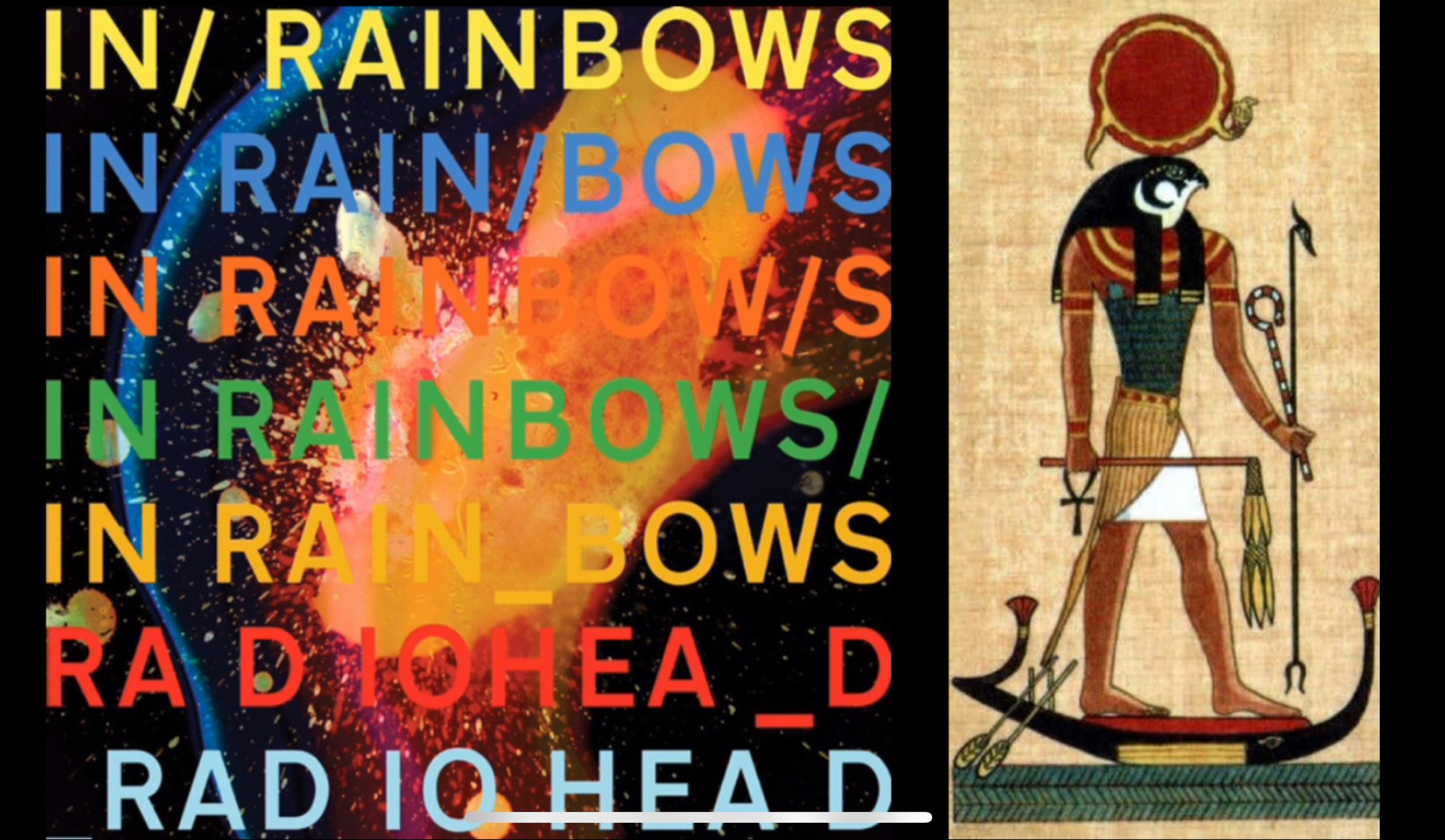
BOOK II: IN RAINBOWS (2007) — THE BOOK OF THE HEART
From the Resonant Frequencies Desk

In Rainbows stands as the apocryphal text, the moment the creation may have exceeded the creators intent. It is Radiohead’s unequivocal masterpiece not because it is the most perfect execution of their mandate, but because it achieves a tragic humanity so complete that it shatters the mandate itself. It becomes the ultimate cautionary tale, an antidote forged in the fires of its own poison. If OK Computer is the cold, diagnostic manual, then In Rainbows is the intimate, human experience of the diagnosis itself. It is the Weighing of the Heart Ceremony from the Egyptian Book of the Dead, translated into a modern, digital age tragedy. Here, the aristocratic Observer does not merely report, he presides over the scales of Ma’at, judging the souls of a classic love triangle.
This album stands in contrast to the reading of Radiohead’s work as a form of social diagnostics. Here, the focus shifts from the political to the profoundly personal, functioning not as a tool of control but as a devastatingly human, Faustian exploration of an extramarital affair with tragic consequences. It is a masterpiece of narrative cohesion disguised as a collection of songs. We find our aristocrat older and far more impressive. This modern Greek tragedy is a story as old as time containing 4 characters: The Husband, The Wife, The Lover, The Observer. And it is ‘dedicated to all human beings’.
ACT I: THE PROLOGUE – DIAGNOSIS AND DESCENT
Track 1. 15 Step
(The Prophecy of Panic)

‘15 steps, then a sheer drop`
The Observer begins not with the affair, but with a diagnosis. The frantic energy is the Lover’s chaotic frequency, but the lyrics are the Observer’s voice, directed at the Husband. “You used to be alright/what happened?” a direct question as to why the man has lost his stability, perhaps urging action or a waking from his passive state. However the Observer coldly prophesizes the entire arc of the album: the “15 steps” are the tracks to come, and the “sheer drop” is the suicidal end awaiting the Husband. It is a declaration that this is a story about, as Thom Yorke said in an interview, the “panic of knowing you are going to die” and its catastrophic consequences.
2. Bodysnatchers
(The Hollow Tempter)

‘I have no idea what I am talking about / I’m trapped in this body and can’t get out`
The Observer immediately introduces the agent of chaos fully: the Lover. This is a vicious portrait of hollowness. He is not a romantic hero but a frantic, empty shell “trapped in this body.” The Observer judges him as a fundamentally destructive force who undermines truth and stability saying he ‘killed the sound and removed the backbone”and is a puppet. He is the Mephistopheles to this tragedy.
3. Nude
(A Flashforward to Regret)

‘Now that you’ve found it, it’s gone / Now that you feel it, you don’t`
In a masterstroke of narrative sequencing, the Observer shows us the end of the Wife’s emotional journey before the affair even begins. This is her elegy of regret and it is beautifully sung. The “big ideas” of escape and passion are already revealed as illusions. The devastating couplet captures the affair’s hollow core, that the ecstasy she sought vanishes upon grasp, leaving only guilt. The Observer casts a pall of inevitable sorrow over the seduction to come.
ACT II: THE AFFAIR – THE SYMBIOSIS OF NEED
4. Weird Fishes / Arpeggi
(The Hypnotic Plunge)

‘Everybody leaves if they get the chance, and this is my chance`
The seduction begins. From the Wife’s perspective, the pull is hypnotic and irresistible. The logic of temptation is flawless: “I’d be crazy not to follow.” Her rationalization “Everybody leaves… this is my chance”is the signing of the Faustian pact. She willingly plunges into self annihilation: `I get eaten by the worms and weird fishes` and he ‘hits the bottom/bottle and escapes’.
5. All I Need
(The Pathology of a Shared Delusion)

‘I am a moth who just wants to share your light`
This is the strange heart of the affair. The Observer reveals a terrifying triangulation of perspectives, all completely interchangeable
For the Lover, it’s parasitic: he is a “moth” drawn to consume her light.
For the Wife, it’s a confession of emptiness: he is merely the only available escape from her life.
For the Husband, it’s his worst fear imagined: a projection of his own inadequacy and replacement.
The shared mantra, `It’s all wrong, it’s all right`, is the sound of their collective conscience being silenced. This is not love, but a shared delusion of need.
6. Faust Arp
(The Unraveling)

‘You got a head full of feathers’
The perspective shifts to the Husband. The title confirms the Faustian theme. The Observer finds him in a state of bewildered unraveling. “The elephant that’s in the room is tumbling, tumbling ” is the chaotic, collapsing force that can no longer be ignored. He senses the affair on the periphery of his life but is powerless, or unwilling, to confront it yet. He is already coming undone. ‘Wakey, wakey, rise and shine / It’s on again, off again, on again`. The Observer’s voice is clear here, a sarcastic, cruel alarm clock jerking the Husband out of his denial and into the cyclical nightmare of suspicion. It’s his diagnosis of the Husband’s state as lightweight, unsubstantial (“feathers”), and dissolving under pressure, losing his form (“melted to butter”). Then the central conflict of the affair ‘It’s what you feel, not what you ought to`, It’s the hedonistic justification for the betrayal (“what you feel”) versus the moral duty (“what you ought to”). The Husband is tortured by this dichotomy.
‘Reasonable and sensible, dead from the neck up / I guess I’m stuffed`
This is his self-assessment. He followed the rules (“reasonable and sensible”), and it got him nowhere, it left him emotionally lifeless (“dead from the neck up“) and now utterly defeated (“stuffed”).then ‘I love you but enough is enough, enough of that stuff` This is the heartbreaking core. It’s the last gasp of his love and reason before the despair completely swallows him. It’s a plea for the madness to stop.
ACT III: THE RECKONING – REALIZATION AND RUIN
7. Reckoner
(Transcendent Acceptance)

‘Because we separate like ripples on a blank shore`
Within the narrative of In Rainbows, “Reckoner” is not merely a song, it is the spiritual and philosophical core of the entire album. It is the moment the story transcends its specific, sordid details and achieves a devastating, universal grace. It is the betrayed Husband’s moment of transcendent acceptance immediately before the end.
‘You can’t take it with you`
Faced with the betrayal, the Husband understands that the pain, the anger, the attachment to his former life and identity, none of it matters. None of it can be taken into whatever comes after. It is a statement of radical letting go and realization.
‘Dancing for your pleasure / You are not to blame for / Bittersweet distractor`
This is the ultimate absolution. The Observer gives the Husband a voice of a distant empathy. He does not condemn his wife or the Lover. He sees them not as malicious monsters, but as flawed humans, “dancing for pleasure,” caught in a “bittersweet” temptation they could not resist (`Dare not speak its name`). He releases them from his judgment.
‘Dedicated to all you / All human beings`
This is the moment the personal becomes universal. His personal tragedy expands into a compassion for all of humanity. He is no longer just a betrayed man, he is a witness to the human condition, and his song is for everyone.
‘Because we separate / Like ripples on a blank shore`
This is the album’s central thesis on the nature of connection, rendered in its most beautiful and heartbreaking imagery. All relationships, all loves, all lives are temporary. They connect, they interact, and then they fade away `like ripples on a blank shore`. His marriage was merely one such ripple. This is not a bitter observation, but a peaceful, if utterly sad, acceptance of a possibly fundamental truth.
‘Reckoner, take me with you`
The “Reckoner” is the agent of this cosmic truth, the force of death, fate, or time that balances the books and enforces this law of impermanence. His plea is not one of fear or despair, but of readiness. After achieving this profound understanding, he asks for release from the painful, temporary world. He wants to be “taken” into that state of permanent peace where the ripples finally calm. Here, the Observer reaches their peak of empathetic curation. They don’t just report the Husband’s suicide; they give him a voice of stunning philosophical clarity and grace. They show that his final act is not one of cowardice, but of a tragic, partly enlightened choice. The Observer frames this not as a single man’s failure, but as a universal poem on love and loss. It is the calm, devastating eye of the storm being the moment of perfect understanding that makes the inevitable ending not just tragic, but tragically beautiful. Yet perhaps this is also the moment where the Aristocrat is at his most dangerous and insidious, holding up this reaction and insight as the profound truth and the following suicide as a subtly suggestive ‘enlightened choice’. Being shown this utter collapse of the husband before house of cards, puts us in the role of the observer, we know the result before we are shown the start, making it all the more tragic.
8. House of Cards
(The seduction )

A still from the LIDAR-scanned music video for ‘House of Cards’. The affair rendered as pure, disembodied data points. A perfect visual metaphor for the hollow core of the relationship: shimmering, ethereal, and devoid of tangible humanity. (Credit: Google/Radiohead).
The song itself is masterfully seductive, as is the video. The lover sounds utterly infatuated in his seductive plea for her to “Forget about your house of cards/and I’ll do mine`. The observer, with cold omniscience, interjects the inevitable outcome: `The infrastructure will collapse` and a warning to the husband ‘your ears should be burning’ It was never a matter of if, but when.
9. Jigsaw Falling Into Place
(The Climactic Confrontation)

‘Jigsaw falling into place, so there is nothing to explain`
The Observer hurls us into the frantic climax. This is the night the Husband confronts the truth. The lyrics are a breathless, real time account of his reality distorting (`The walls are bending shape`). The title is the moment of horrifying, final clarity: all the deceptions and lies snap together into one undeniable picture of betrayal. `There is nothing to explain`.
10. Videotape
(The Suicide Note)

‘Mephistopheles is just beneath, and he’s reaching up to grab me`
The aftermath is this stark, funereal suicide note. The “videotape” is the Husband’s final testimony. `Mephistopheles is just beneath` confirms the Lover as the devilish tempter who has claimed his prize. The final line is the most haunting: his decision to end his pain, after the transcendent acceptance of “Reckoner,” brings him a perverse, peaceful clarity. It is the ultimate, tragic end to the Observer’s prophecy.
In Rainbows is a curated tragedy. a lament for the fragile architecture of human connection, a “house of cards” built in that fragile light, destined to collapse under the weight of its own impermanence .The observer is the album’s narrative consciousness: a moralist and an aesthete. They have not just told us a story, they have conducted a flawless autopsy. And therein lies the secret and the poison. I wondered why I felt unease earlier with the Reckoner, and this is why. The Observer has grown immensely since we met him in OK Computer. He is bigger, more spiritually grown, and wiser. His understanding of the human condition has naturally expanded. But he is also more dangerous. He is no longer in the storm. He is above it, arranging the clouds. He is utterly In control. Never frantic. He opens the album with a prophecy (“15 steps, then a sheer drop“) and executes it with calm precision. His focus is internal, the human heart, its desires, its capacity for self destruction. He has moved from diagnosing society to dissecting the soul. The poison is not nihilism. It is aestheticized tragedy. That’s to say the presentation of despair and suicide not as a failure, but as a profound, even beautiful, philosophical choice. The Observer on In Rainbows is not “more empathetic” in a simple, human sense. He possesses a godlike empathy, the ability to fully comprehend and articulate the depths of a feeling. This is not the same as compassion. He empathizes with the Husband’s despair so completely that he can write him the perfect suicide note (“Videotape”). He empathizes with the Wife’s regret so deeply that he can articulate it before the affair even begins (“Nude”). He understands the Lovers emptiness with such clarity that his portrait is merciless (“Bodysnatchers”). This is the work of a master psychologist, not a friend. He doesn’t seek to heal, he seeks to understand and display. He is the ultimate artist, for whom human experience is his medium. He is selling the idea that profound understanding can be found in collapse, and that beauty is the highest value, even if its source is absolute ruin. This is far more dangerous than the angst of OK Computer, OK Computer still makes you want to break the system. In Rainbows can make you want to elegantly destroy yourself. It doesn’t just report on the panic of modern life, it offers a devastatingly attractive, quietist solution to it. His mastery is not in selling the same poison more skillfully. It is in distilling a new, more potent, and addictive poison: the notion that within our greatest tragedies lies our most exquisite art, and that to truly understand life is to see the aesthetic perfection in your own end.
So who is the Observer really?
To fully grasp the Observer’s essence, we must move beyond metaphor and recognize his literal identity encoded within the very fabric of the artwork for In Rainbows. The name Radiohead is not merely a band label it is a modern hieroglyph, a cryptographic key revealing the Observer’s true nature.

RA D IO HEA_D
Deconstructing “Radiohead” unveils a sacred formula:
– RA: The sun god, embodying judgment, order, and cosmic authority. Ra represents the ultimate Observer, omniscient, detached, and sovereign over life and death.
– D: The mountain (djew) ,symbolizing eternity and the immutable landscape of the underworld (Duat), where mortal dramas unfold.
– IO: The cry of the soul,anguish, lamentation, and the raw sound of human vulnerability.
– HEA_D: The severed head, intellect divorced from body, a direct reference to the Weighing of the Heart ceremony, where the soul’s fate is decided.
So there you have it, this decoding transforms the Observer from a narrative device into a primordial archetype. He is not merely an aristocratic curator but a divine entity presiding over a modern Duat, where human lives are weighed against the feather of Ma’at (truth). The Observer is revealed as the ancient Egyptian sun god and divine judge of the dead. Ra, the embodiment of ultimate judgment, cosmic order, and detached omniscience. He is the final arbiter of moral and cosmic order. This is the precise function of the Observer in In Rainbows. He does not merely document tragedy; he orchestrates it as a sacred ritual. As Ra, he embodies a divine duality: both creator and destroyer, a figure whose “godlike empathy” is not channeled toward solace but toward cold, implacable judgment, a divine acknowledgment of human frailty that nonetheless enforces inexorable laws. The entire narrative of the album mirrors the Weighing of the Heart ceremony, where the Husband’s heart, heavy with grief and betrayal, is measured and found wanting. His subsequent suicide in “Videotape” is therefore not a personal defeat but a divine verdict, a serene acceptance of a cosmic imbalance that must be corrected. This framework elevates the album from a mere psychological study into a full mythological enactment, where the Observer does not diagnose but pronounces fate.
This role manifests a profound philosophical paradox, echoing Eastern philosophies that assert ‘the observer is the observed’. The Observer’s duality is his most defining feature. He is both the curator of the tragedy and its ultimate product. His aristocratic detachment is an illusion. He is fundamentally entangled with the very souls he judges. This is perfectly expressed in “Reckoner,” where the plea to “take me with you” signifies the soul’s deepest yearning to merge with the divine Observer, to finally dissolve the boundary between the judged and the judge. In this light, the Observer is not an external force but the cosmic consciousness inherent to the human experience, the part of us that witnesses collapse with both terror and awe.
His artistry, therefore, lies in his preternatural ability to transform base suffering into beauty. He is a visionary who uses human emotion as his pigment and tragedy as his medium. His work is not crafted from sound or canvas but from raw human experience itself. He functions as a conduit for unbearable truth, forcing us to feel the precise weight of our own hearts upon the scales. This aligns with the sacred function of art as a mirror to the soul, a portrait of our innermost fears and desires. The album, under his guidance, becomes a riddle that reflects the listener’s own being back at them, completing the circuit of the ritual. And it confirms the album’s ultimate purpose, to stage a modern Book of the Dead, a ritual where every listener must undergo their own weighing of the heart.
A Final Hieroglyph: The Scribe’s Signature
Yet, then I saw there was another clue that forces a refinement of this divine hierarchy. The overarching authority is indeed RA but the active voice we hear, the hand that meticulously records the proceedings, belongs to his executor: Thoth, the divine scribe, mediator, and master of all magic and language. This ultimate revelation is signed in the plainest of sights in the artist’s own chosen name, Thom. This is not a casual abbreviation or a simple nickname, it is a modern sigil, a deliberate and cunning homage to the ancient god of writing and judgment. Thoth is the perfect archetype for the artistic persona we hear being the eternal scribe who records the verdict of the Weighing of the Heart, the master of codes who hides meaning in the intricacies of language, and the essential mediator who translates pure divine terror into transformative human art. So the dynamic is perfected and the pantheon is complete: Thoth (Thom) is the voice; Ra is the will. The scribe executes the sacred ceremony under the ultimate authority of the sun. The Observer is not a single god but a divine collaboration, a complete metaphysical framework invoked to architect a modern reality where every listener is both the accused and the jury, compelled to face the scales.

‘and the heat goes on where the hand has been’ (Talking heads ‘Born under Punches’)
THE HIEROPHANT’S VERDICT
The album’s power stems from its perfect, unresolvable tension. It is a devastating cautionary tale delivered through the medium of an exquisitely aestheticized tragedy. This is not a contradiction but the core of its ancient design. Through the Egyptian framework, the Observer performs a sacred function: he is both the high priest who warns of the underworld’s dangers and the god who records its fatal verdicts with transcendent impartiality. His method is one of sublime, aristocratic curation. He understands that a mere moral lecture is impotent. Instead, he immerses us in the lush, hypnotic beauty of the affair’s genesis (‘Weird Fishes’, ‘House of Cards’) only to guide us, with calm, prophetic precision, to its inevitable end: the hollowed out “bodysnatcher,” the Wife’s eternal regret in ‘Nude’, and the Husband’s stark suicide in ‘Videotape’. The cost is not stated instead it is rendered in the most spiritually serene and aesthetically perfect terms imaginable.
This is the ultimate expression of the godlike empathy we identified, a comprehension so total it becomes dangerous. In ‘Reckoner’, he grants the Husband the clarity to absolve others and perceive a cosmic truth (“We separate like ripples on a blank shore”). Yet this empathy is not for healing, it is for judgment. It makes the subsequent suicide not a scream of despair, but a sigh of acceptance, a logical conclusion to a philosophical journey. This is the “poison”, the artistic alchemy that transforms despair into a form of enlightenment, making the fatal outcome feel not just inevitable, but spiritually correct.
And yet, this is precisely what makes it the ultimate antidote. The Observer uses this beautiful fatalism as his only and most potent tool for moral instruction. By making the conclusion so aesthetically compelling, he demonstrates the catastrophic cost of reckless desire with a clarity that mere moralizing could never achieve. The album administers a controlled, beautiful strain of the disease (the desire for escape) to build an immunity to it (a renewed, fearful appreciation for stability).
Therefore, the “poison” and the “antidote” are the same substance. The Observer offers the devastatingly attractive solution of self-destruction only to show us its horrific conclusion. He is the moralist who makes immorality look tragically beautiful, and the aesthete who uses beauty to warn against temptation. In the end, the Aristocrat has not just diagnosed the disease, he has offered a devastatingly beautiful, and ultimately fatal, cure. He has used the ultimate tool of art, beauty, to make the ultimate case for order. He has made recklessness look so tragically sublime that we are both mesmerized by it and terrified to succumb to it. This is the ultimate, dizzying double-bind of the project, and its most astonishing achievement: to use the most seductive portrait of collapse as the definitive argument for the fragile, imperfect architecture of human connection.
Epilogue: The Ankh
This decoding of intent is not just an intellectual exercise, it is a personal one, triggered by a moment of inexplicable synchronicity from my youth. When I was a young lad on a family holiday in Cornwall, I strangely found an Egyptian ankh washed up from the sea. It lay on the wet sand, a stark anomaly, seemingly made from crude iron. Neither I, nor later my family, recognized it as anything other than a curious trinket, it’s possible significance utterly lost on us. I wore it for a week until it disintegrated. I mention it as It’s only recently that this memory keeps coming back to me. Thinking about it retrospectively, it feels to me like a moment of uncanny resonance. I did not understand it then. I am only starting to understand it now. The ankh is said to be the mysterious ancient symbol for life, true life, a vital force that transcends the material. It was a key. And if it was a key for me, then the encounter was a silent summons to look for the eternal pattern within the ephemeral, to listen for the mythic chant within the modern noise. This work, the tracing of bloodlines, the decoding of albums as funerary texts, the hearing of a god’s plan in a rock song, decades later, has been a part of my answer to that summons. The ankh may well have been the logo of the RA corporation, but the control system was never total. It was returned by the sea. The true keys to the kingdom are still lying around, waiting to be found by those who are ready to see them for what they are
Radiohead’s In Rainbows is their Book of the Dead. This essay is mine.
Join me next time for the explosive final part of this series.
I’ll leave you with a final visual representation of a song from Amnesiac released in the period between OK Computer and In Rainbows.
Pyramid Song


Leave a Reply