The Egyptian Seed: Tracing the Roots of the Kabbalistic Tree
From The Desk of The Solar Barque
We often treat spiritual systems as isolated creations, springing fully formed from the genius of a single culture. Kabbalah is viewed as a uniquely Jewish mystical tradition. But what if its deepest symbols, the Tree of Life, the sefirot, the descent of divine light, were nurtured in a far older soil? A strong case can be made that the conceptual seeds of Kabbalah were sown during the Hebrew sojourn in Ancient Egypt. The Exodus, then, was not just a geographical journey, but a transfer of profound metaphysical ideas from the banks of the Nile to the heights of Sinai.
The connection is not one of direct copying, but of creative transformation. The Hebrews, immersed in Egyptian culture for generations, internalized its core cosmological symbols and then, through the revolutionary lens of monotheism, refined them into a new system.
The Sacred Tree: From the Nile to the Zohar
The concept of a cosmic tree as the axis of creation is quintessentially Egyptian. The Hebrews would have been intimately familiar with symbols like the Persea tree, upon whose leaves the pharaoh’s name was written for eternity, and the Sycamore Fig of the goddess Nut, which offered nourishment to souls in the afterlife. These were not just plants; they were symbols of divine knowledge, eternal life, and the central pillar of the universe.
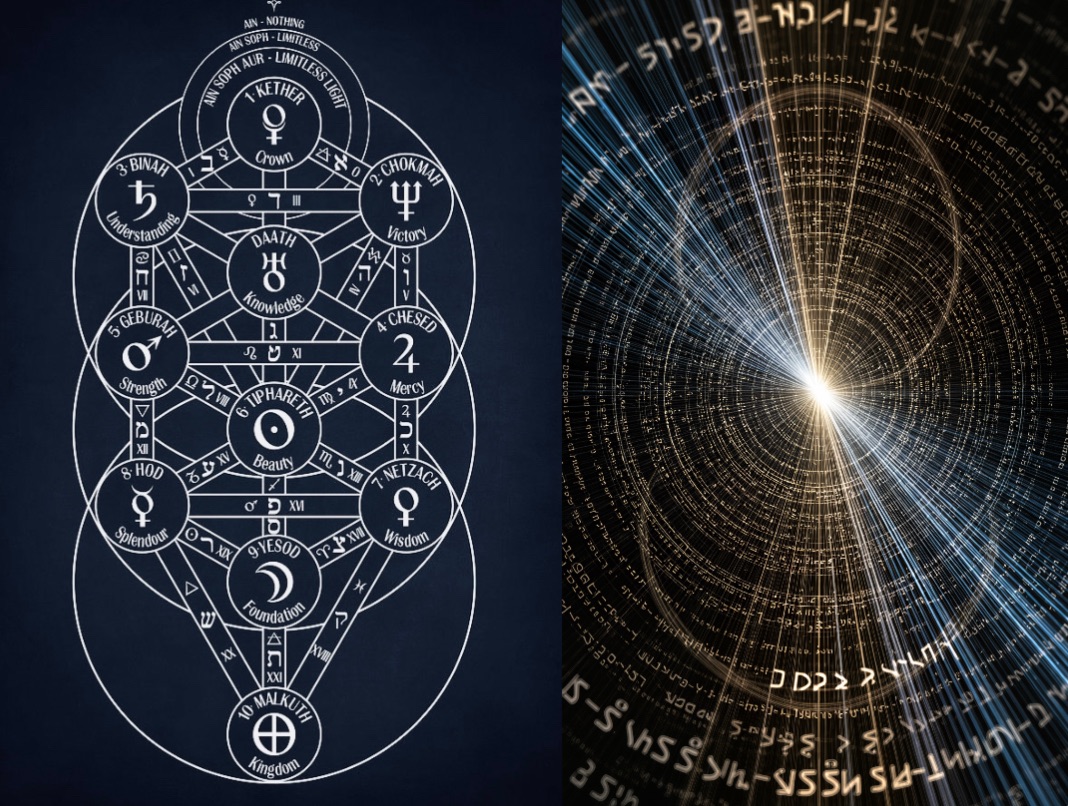
It seems less an accident and more a natural evolution that this powerful archetype was transformed within Hebrew thought. The “Tree of Knowledge” in Eden and the later, elaborate Etz Chaim (Tree of Life) of the Kabbalists appear as a reworking of this deeply internalized Egyptian motif, purposed for a new theological vision.
The First Chain of Divine Light
The primary Egyptian creation myth from Heliopolis presents a blueprint that Kabbalah would later follow. It begins with Atum, the primordial god, emerging from the chaotic waters of Nun, a concept strikingly similar to the Kabbalistic Ein Sof, the Infinite. Atum then emanates the other gods: Shu (air) and Tefnut (moisture), who give birth to Geb (earth) and Nut (sky), forming the Pesedjet (the Ennead).
This is a clear precursor to the Kabbalistic process of emanation. The sequence from a unitary source to a complex reality through a series of divine manifestations is structurally identical. The Egyptian gods, as personifications of natural forces and principles, prefigure the impersonal, abstract sefirot.
The Gods as Attributes & Principles
The Egyptian pantheon can be understood as a system of divine attributes emanating from a single source. This perspective reveals a deep structural parallel with the sefirot.
Ma’at, the goddess of truth and cosmic order, is not just a deity but the principle of divine harmony, a direct parallel to the sefirah of Tiferet (Beauty) & Thoth, the god of wisdom and knowledge, is a clear analogue for Chokhmah (Wisdom).
The Hebrew innovation was to synthesize this complex worldview into a staunchly monotheistic framework. The many “gods” were re-envisioned as the multifaceted attributes of the One God.
A Monotheistic Revolution
The Hebrews did not simply borrow these ideas. They synthesized and revolutionized them. The experience at Mount Sinai, where God revealed Himself through law and sound, not an image, was the catalytic moment. It was there that the familiar Egyptian concepts of divine manifestation were stripped of their polytheistic forms and recast into a new, monotheistic mystery. The architecture of emanation remained, but its source was now absolute and unified.
From the Nile to the Kabbalists of Safed
The parallels are too deep and too structural to be dismissed. The Kabbalistic Tree of Life is not a sudden appearance in medieval Spain; it is the culmination of a long gestation. Its roots reach back through the Talmudic sages, through the prophets, and across the Sinai desert to the Nile Valley.
This is not to diminish the genius of Kabbalah, but to illuminate its origins. The great Kabbalists of Safed were not just inventing; they were remembering and refining—uncovering a hidden architecture of the divine that their ancestors had first encountered in the shadow of the pyramids. The journey from the Egyptian Book of the Dead to the Zohar is not a leap, but a journey along a well-trodden path of mystical transmission.
The Nile, it seems, flows into the river of Binah, the great sea of understanding.
Leave a Reply