HOW A PHARAOH’S STANDARD, A BIBLICAL MIRACLE, AND A MODERN VICTORY ARE LINKED BY A 5,000-YEAR-OLD WORD (Part 2)

From the Historical Reincarnations Desk

From the primordial waters of an Egyptian god to the roar of a Turkish football crowd, a single, potent linguistic archetype has echoed through history. This is a further exploration of the N-S root, a sound sequence that, across languages and millennia, has consistently encoded the concepts of the divine, the miraculous, and the victorious. It is a pattern that connects the deepest myths of ancient civilizations to the symbolic dramas of the modern world.

The Primordial Source

Nun, Nys, and the Waters of Potential

Our journey begins not with a word, but with a sound in the void. In Ancient Egypt, before creation, there was Nun (Nwn), the dark, primordial watery abyss. It was chaos, but also infinite potential, the source from which the first god and all of existence emerged

Nun
Egyptian god Nun raising the solar boat with the sacred scarab beetle and seven gods; detail of a papyrus from the Book of the Dead of Anhai.
Charles Walker Collection/Alamy

Echoing this concept is the Greek primordial deity Nysos. His name is not a coincidence; it is the linguistic and conceptual bridge. The sound “Nys-” captures the same primordial, generative energy as “Nun.” As a Protogenoi (primordial god), Nysos represents the foundational, formative impulse of the world itself. His domain, the mythical Mount Nysa, was a hidden sanctuary, the nurturing source of miraculous transformation.

This role is crystallized in the most famous myth associated with him: the birth and upbringing of the god Dionysus. Zeus entrusted the infant god to Nysos and his daughters, the Nysiads, to be raised in secret and safety. In this hidden, primordial cradle, the future god of ecstasy and transformation was protected, his very name, “The God of Nysa,” forever binding him to this source. Here, the potential of the divine child was nurtured into world-altering power.

Thus, the N-Y/N-S sound sequence, from the formless potential of Nun to the formative source of Nysos, establishes the first layer of our archetype: the primordial wellspring from which miracles are born.

But the archetype of the primordial source is not confined to Egypt and Greece. A stunning conceptual and linguistic parallel emerges from the heart of Jewish mysticism: Ein Sof (אין סוף).

Ein Sof, meaning “Without End” or “The Infinite,” is the Kabbalistic term for the ultimate, unknowable God prior to creation, the absolute, formless source from which all existence emanates. Strikingly, if we look past the vowels to the core consonantal skeleton of the words, a pattern emerges:

  • The Greek primordial source: Nys- (N-S)
  • The Egyptian primordial source: Nun- (N-N)
  • The Kabbalistic primordial source: eN-SoF (N-S-P/H)

The shared N-S core is unmistakable. The addition of the Pei (P/F) in “Sof,” a letter associated with ‘mouth’ and ‘breath,’ could be seen as the phonetic moment this infinite potential begins to express itself. This suggests that the ‘N-S’ root does not merely represent a source, but The Source itself, the ultimate, unnameable wellspring of reality, echoing across cultures, from the waters of Nun and the mountain of Nysa to the infinite void of Ein Sof.

The unknowable primordial source

The pattern of the primordial ‘N-W/S’ archetype is not a merely Western phenomenon. It finds one of its most powerful expressions in the very foundation of Chinese mythology with the goddess Nüwa (女媧).

Strikingly, her name carries the core consonantal root N-W, a direct phonetic echo of the Egyptian primordial abyss, Nun (N-W-N). While Nun was the passive, watery potential, Nüwa is that potential awakened into active, creative force.

As the mother and creator of all humanity, who shaped humans from yellow earth and mended the broken pillars of the sky, Nüwa embodies the archetype in its most profound aspect: the primordial source as the conscious, loving creator. She is not just the chaos before creation; she is the intelligence that brings order from it.

From the formless Nun to the formative Nysos, from the infinite Ein Sof to the creator Nüwa, the ‘N-W/S’ root reveals itself as a global linguistic signature for the ultimate source of reality.”

Nuwa & Fuxi by an anonymous artist

The Divine Standard

Netjer and the Making of a God

From the waters of Nun emerged the gods, and the Ancient Egyptians had a unique way of writing their word for “god“: nTr (Netjer). The hieroglyph was a flag on a pole, a standard. This was no arbitrary choice. The temple standard was the visible marker of a god’s dwelling place, the rallying point for their power and presence. Here, the sound N-T-R directly links the divine to the symbol of the raised standard.

The Hieroglyph for Netjer

The Miracle Unveiled

The Hebrew Nes and its Semantic Field

This Egyptian concept finds a stunning parallel in Hebrew. The word Nes (נֵס) holds a double meaning that is the very key to our archetype. Its primary meaning is a “standard” or “banner” raised high as a signal. But this visible sign evolved to mean a “miracle“, a divine act that serves as a signal or proof of God’s power. The “miracle” is the function of the “standard.” The two are inseparable.

This core concept, Nes, exists within a powerful semantic field:

  • Nazir (נָזִיר): The “consecrated one,” a person set apart for God, like a human standard.
  • Chasa (חָסָה): “To seek refuge.” A standard (Nes) is where one finds shelter (Chasa). The miracle provides the safety.

The Biblical examples are perfect manifestations, where the parting of the Red Sea was a Nes (miracle) that created a path (a Nes as a rallying point) leading to shelter (Chasa) and a new home.

The Victory Chant

The Arabic Nasr and the Cycle of Triumph

Moving into Arabic, the root N-Ṣ-R (ن ص ر) completes the cycle. It means “to help,” “to grant victory.” Nasr is victory itself. If Nes is the miraculous sign, Nasr is the victorious result. This is embodied in names like Nasrullah (“Victory of God“) and titles like Al-Nasir (“The Helper,” one of the 99 Names of Allah). The Ansar, the “Helpers” of Medina, were the human agents of this divine victory. The archetypal chain is now clear: a Nes (miracle) leads to Nasr (victory), which provides Chasa (shelter).

Historical Incarnations

Standards Raised, Cities Won

This archetype did not remain abstract, it shaped history.

On the eve of the Battle of the Milvian Bridge, Constantine the Great had a vision of the Chi-Rho symbol in the sky. A divine Nes, that led him to create the Labarum, a sacred standard. His subsequent Nasr (victory) began the Christianization of the Roman Empire.

We looked at Ulubatlı Hasan & The Komnenos Secret in part 1. The legend of the Ottoman warrior who planted the standard on the walls of Constantinople in 1453 is a classic Nes. His act secured the ultimate Nasr for the Ottomans, and the city became their Hasa.

The Archetype in Rank and Title

The Miracle of Majesty

The archetype did not only manifest in war and sport; it was also woven into the very fabric of social and divine order. Consider the English honorific “Your Royal Highness.” The suffix “-ness” (from Old English –nes, meaning “state or quality of being”) transforms an adjective into a condition of exalted existence. While linguistically distinct from the Semitic Nes, the conceptual parallel is striking: the title elevates a person to a symbolic standard, a living embodiment of a state of grace and authority to which others rally. The monarch becomes the Nes, the standard and the miraculous exception to ordinary human rule.

This pattern of elevation is ancient. The Egyptian Pharaoh, a nTr (god) on earth, was the ultimate living standard. The Byzantine title “Basileus” (sovereign) carried the same weight. The N-S archetype, therefore, also governs the concept of sanctified authority, where a ruler’s person is the miracle and the rallying point.

The Maid and the Standard

A Nes in Armor

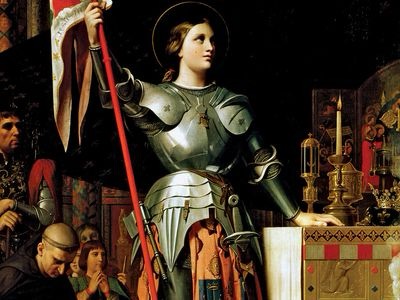
The archetype finds a stunningly pure expression in the story of Joan of Arc. Her claimed divine visions were the Nes (the miracle) that propelled her to the dauphin’s court. Her insistence on carrying a sacred banner into battle made her the literal and symbolic standard-bearer. The victory at Orléans was the Nasr (victory) that flowed from this divine mandate, an event so unexpected it was seen as miraculous itself. The ultimate Hasa (shelter) she provided was the salvation of the French throne. In Joan, we see the complete archetype: the miraculous sign, the raised standard, the decisive victory, and the secured kingdom.

 Joan of Arc at the Coronation of Charles VII in Reims Cathedral, by Jean-Auguste-Dominique Ingres, 1854; in the Louvre, Paris. 

And what of the most iconic standard raising in modern lore? The narrative of NASA planting a flag on the moon serves as a perfect, secular incarnation of the ancient pattern. In the collective imagination, the act was a Nes, a miraculous technological feat presented as a global symbol. It functioned as a Nes for a nation, a signal of its Nasr in the Cold War. The power of the archetype is that it operates on the level of story and symbol; its truth is measured by its cultural resonance, not just its historical veracity

Man on the Moon
Buzz Aldrin stands next to the US flag on the Moon in 1969.
Project Apollo Archive/NASA

The Unquenchable Pattern

From the Nun to Netjer, from Nes to Nasr, from the Nysa-born Dionysus to the Sönmez chants of Istanbul, a pattern endures. It is the pattern of a sign that promises salvation, a victory that provides shelter, a standard that declares a spirit unquenchable.

This is not merely a story of linguistic coincidence. It is a testament to a fundamental structure of human thought. We understand the divine through the metaphor of the visible sign; we conceptualize victory as the result of a miraculous intervention. The N-S root, across languages and epochs, has been a unique vessel for this profound understanding. It is a 5,000-year-old secret hidden in plain sight, a testament to the unquenchable power of a simple, sacred sound.

Leave a Reply

Discover more from The Weighing Of The Heart

Subscribe now to keep reading and get access to the full archive.

Continue reading