The Parser’s Blade
The Single Hebrew Root That Carved Civilization
Before the first word was spoken, the gesture was made. In the opening lines of Genesis, the primordial act of creation is not a gathering, but a division: “And God separated the waters from the waters.” Later, at the birth of a nation, the same gesture is repeated: a path is carved through the sea, parting the waters to create a people. The fundamental act of bringing order from chaos is not to unite, but to separate.
This divine principle is encoded in a single, potent Hebrew root: פ–ר–ס (P-R–S).
We are told it means “to break apart.” A simple, almost violent act. But this is a deception. This root is not a word; it is a key. Insert it into the lock of history, and the hidden doors of empire, scripture, and modern power swing open to reveal a shocking truth: Our world was built not by uniting, but by dividing. And this principle of division, of parsing, is the fundamental gesture of creation, control, and comprehension.
The Genesis of Distinction
From Bread to Boundaries
The principle first reveals itself in the most elemental of human acts: לִפְרוֹס (lifros) lechem, to break bread. This is not destruction. It is the foundational ritual of community, the necessary division that transforms a private loaf into shared sustenance. The whole must be parsed to create relationship.
This same principle is etched into the anatomy of the pure animal: the פַּרְסָה (parsah), a hoof. Its defining feature? It is cloven. Split. Holiness, it seems, is not found in solidity, but in a fundamental, physical distinction. From the very start, P-R-S teaches that definition, the line between one thing and another, is the basis of the sacred.
But this root soon outgrows the physical world. The great scroll of the Torah is not a seamless, overwhelming blur. It is meticulously divided into פָּרָשִׁיּוֹת (parshiyot), portions. Each פָּרָשָׁה (parashah) is a deliberate act of divine parsing, a breaking of the infinite word into digestible, weekly segments. The text must be broken to be received. This is the intellectual counterpart to breaking bread: the whole is parsed to nourish the mind, week by week, for a lifetime.
The Empire of the Parser
Persia and the Art of Division
Then, the root takes a decisive geopolitical turn. We meet פָּרַס (Paras)—Persia. This was not merely a kingdom. It was the empire that institutionalized the P-R-S principle. It did not just conquer; it carved the known world into satrapies, parsing continents into manageable administrative units. Its power was the power of division, the “divide” in “divide and conquer.” Its agent was the פָּרָשׁ (parash), the horseman, not a romantic figure, but likely a mobile enforcer of imperial boundaries, a living instrument of separation.
The pattern is now undeniable. From broken bread to sacred text to the map of the world, a single, relentless logic is at work. And this logic did not stay confined to Jerusalem or Persepolis. It began to mutate, its sound shifting as it seeped into new lands, revealing new dimensions of its power.
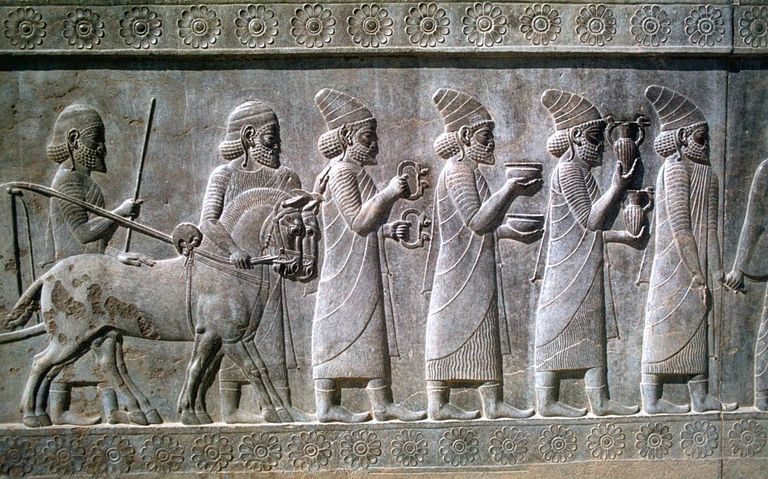
The Egyptian “P-R-S”
The Knife That Parses Reality
The principle of sacred division was not merely philosophical for the Egyptians; it was embedded in their language and rituals. We find it crystallized in the root `psš` (pesesh), meaning “to divide, to split in two.”
This root finds its most profound expression in the `PSS K.F` (the Pesesh-kef), the ceremonial knife used in the vital “Opening of the Mouth” ritual. This was not an act of destruction, but of creation and liberation. The blade was used to ritually “open” the mouth of the deceased, parsing the mummy from its state of inert death and separating its spiritual senses so it could see, breathe, and eat in the afterlife.

Here, in the very heart of Egyptian esoteric practice, we find the same primordial gesture encoded in the Hebrew P-R-S: the act of cutting as the genesis of function and life. The knife that breaks the bread, the blade that divides the waters, and the instrument that opens the mouth to the divine are all manifestations of the same tool: the Parser’s Blade. Egypt did not fear division; it ritualized it, understanding that to make a sacred cut was to define a new reality.
The Greek Mutation
From Power to Judgment (P-R-S to K-R-S)
As the sound of P-R-S traveled north, it mutated. The labial ‘P’ hardened in the Greek mouth to a ‘K’. The context shifted from raw power to the realm of truth, but the core meaning of separation held firm.
It crystallized in the verb κρίνω (krínō)—”to separate, to judge, to decide.” This is P-R-S refined into an epistemological tool. It is the act of intellectual parsing, of breaking an argument into its constituent parts to discern truth from falsehood. From it comes:
- κρίσις (krísis)—a crisis. A turning point, a decisive separation between one state of being and another: health from sickness, peace from war.
- Critic—one who separates good art from bad.
- Criterion—the standard for that separation.
In the Crusades (a word whose sound and substance echo K-R-S), we see this played out on a global scale: a violent, world-historical crisis and judgment that sought to separate Christendom from Islam, creating a binary world through sheer force of will. The Greek mind had taken the parser’s blade and honed it for the arena of ideas and faith.
The Roman Mutation
From Judgment to Stone (K-R-S to T-R-S)
The root traveled west to Rome, where the sound shifted once more, from the Greek ‘K’ to the Latin ‘T’. The P-R-S of the Hebrew parser, now the K-R-S of the Greek judge, became the T-R-S of the Roman engineer.
Here, the concept became stone. Terminus was the god of boundaries. His sacred stone, the terminus, was pounded into the earth, creating an inviolable line between this and that. This was separation made literal, physical, and divine. It gives us:
- Term, Terminal—a limit or end-point.
- Determine—to set bounds to, to resolve.
- Exterminate—to drive beyond the boundary.
This was the institutionalization of division. Roman law, their greatest legacy, is the ultimate parsed structure, a monumental system built on fine, authoritative separations between right and wrong, citizen and foreigner, mine and thine.

In the 20th century, this Roman ideal found its dark apotheosis in the Truman Doctrine and the policy of Containment. The “Iron Curtain” was not just a border; it was a global terminus, a determined line to separate two worlds, a modern day boundary stone guarded by nuclear legions. The limes of the Roman frontier had been rebuilt with ideology and steel.
The Modern World
The Parser’s Digital Kingdom
We now live inside the ultimate parsed reality. The ancient roots have converged into our daily language and technology:
- We parse data, the fundamental act of computing (P-R-S).
- We face economic crises (K-R-S).
- We agree to terms of service (T-R-S).
The internet itself is a universe of portals, controlled separations between domains. A digital “firewall” is a direct descendant of the Roman limes. The CEO in a Silicon Valley headquarters, orchestrating global flows of information and parsing our attention, is a modern day agent of this ancient principle.
The Magician and the Full Meaning of Divide & Conquer
And so we return to the archetype, the master of the Parser’s Blade: Prospero.
From the confines of his cell, Shakespeare’s magician orchestrates his world through division. He parts the sea to create a shipwreck, a violent act of P-R-S. This act initiates the play’s central crisis, the K-R-S that will judge and redeem every character. And all the while, he operates from within the defined bounds of his magical realm, a master of T-R-S.
Prospero is the ultimate symbol of our parsed existence. He demonstrates that power, judgment, and definition are not found in the chaotic whole, but are asserted from a place of strategic separation. He is the god who divides the waters, the king who carves the empire, the judge who weighs the crisis, and the programmer who writes the code.
But this is not merely the logic of empires and algorithms; it is the rhythm of our own minds and the hidden fracture lines of our modern world. We parse the day into hours, our goals into tasks. We face personal crises that force us to separate who we were from who we must become. We set terms for our relationships, defining the boundaries of self. The Parser’s Blade is not just out there; it is the tool with which we each carve out a life from the raw material of existence.

And on a grander scale, this same blade has parsed our very pursuit of knowledge and community. The story of the Tower of Babel is the ultimate myth of this division. Humanity’s attempt to build a tower to heaven, a project of pure, unified ambition, was thwarted by a divine act of P-R-S: the confusion of tongues. This was not merely a punishment, but a primordial act of parsing that created the very conditions of cultural and linguistic separation we navigate today. Academia itself has been conquered by this principle, its unified quest for wisdom divided and conquered into isolated specializations, each department a satrapy of the mind, speaking its own parsed Babel-tongue behind its own terminal walls.
Our politics, too, have been perfected by the Parser’s Blade. It is no longer enough to separate by nation or class. Now, every identity, every opinion, every facet of life is mined for a potential schism, manufacturing crises (K-R-S) to set group against group, and then imposing rigid terms (T-R-S) of engagement that forbid reconciliation. This is ‘Divide and Conquer’ refined into a science of societal management.
The root פ–ר–ס was never just a word. It was a prophecy. It foretold a world carved into nations, laws, data streams, academic disciplines, and political identities. And in tracing its path, we uncover the profound, layered truth behind the maxim ‘Divide and Conquer.’ It is not merely a military strategy. It is a three-part doctrine:
- Divide (P-R-S): The physical, intellectual, and social act of breaking the whole into manageable pieces.
- And (K-R-S): The crisis of judgment that this division inevitably provokes and is strategically manufactured to control.
- Conquer (T-R-S): The final imposition of fixed boundaries, laws, terms, and ideologies upon the newly parsed reality.
Our civilization was not just built. It was carved by the Parser’s Blade, the enduring instrument of all who seek to understand, to judge, to rule, and to fracture. It is the first gesture of creation, and the final form of control.
The root פ-ר-ס was never just a word. It was a prophecy. It foretold a world carved into nations, laws, data streams, and identities. We now live inside the parsed reality it engineered. We are the inheritors of the Blade.
This revelation leads to a profound and urgent question: If the Parser’s Blade is the fundamental instrument of our world, carving order from chaos and identity from the void, is division our inescapable fate? Is there a counter-force, an equally primordial principle that offers not definition, but connection? Not the boundary, but the bond?
The answer lies not in a word, but in a symbol: the eternal embrace of the entwined serpent.
From The Babel Desk
Continue to Part 2: A Defence of Unity – The Entwined Serpent and the Memory of Wholeness”
Leave a Reply